Okay, So Not Everyone Buying Peptides Wants to Drop Pounds. Let’s Talk About the Other Shelf.

Here’s a thing I’ve noticed hanging around peptide forums and group chats: everyone assumes the whole conversation is about weight loss. And sure, that’s where the big splashy numbers live. But every time I bring this topic up with actual humans in my life, half of them aren’t thinking about the scale at all. They’re thinking about their cranky right shoulder. Their Achilles that never quite bounced back from that half marathon in 2022. Their sleep, their energy, that vague “am I aging okay?” feeling that creeps in around your late thirties.
That’s the recovery and wellness shelf. BPC-157 for tendons. TB-500 for soft tissue. Sermorelin and CJC-1295, the growth-hormone secretagogues promising better sleep and a leaner body composition. If that’s you, pull up a chair, because I want to walk through what you’d actually be buying, and why the safer path here looks a little different from what the marketing tells you.
Let’s start with the uncomfortable truth: the evidence here is a different animal
Literally. Stick with me.
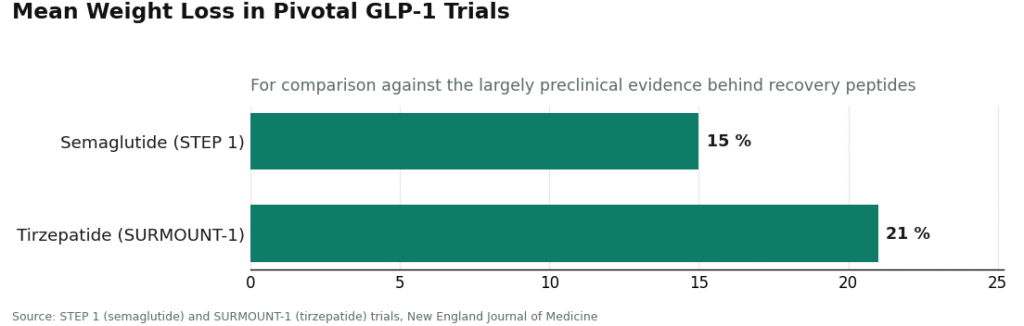
When people lump “peptides” together as one big category, they quietly borrow credibility from the GLP-1 side of the house. Semaglutide and tirzepatide have real, large-scale human trials behind them, semaglutide landing around 15 percent mean weight loss in the STEP 1 trial, tirzepatide around 21 percent in SURMOUNT-1 [C6][C7]. That’s serious, gold-standard science.
Now hop over to BPC-157, probably the most Googled name on the recovery shelf. I’m not going to pretend the research is nothing, because it isn’t, but it’s almost entirely preclinical. A 2026 review in the journal Pharmaceuticals lays out its proposed cytoprotective mechanisms, all documented in animal models of injury [C9]. Rats, basically. Fascinating rats, but rats. If a vendor tells you BPC-157 is “clinically proven” to heal your tendon the way it healed some poor lab animal’s gut lining, that’s a sentence doing a lot more work than the science can support, and I’d start being suspicious of everything else they’re telling you too.
So here’s my actual organizing idea for this whole piece, because I think it clarifies everything: picture the evidence for these compounds as rungs on a ladder. GLP-1s are way up top, standing on massive human trials. BPC-157 and its cousins are a few rungs down, standing on animal studies and hopeful mechanisms. And stacking two or three of these things together, which I’ll get to, is basically standing on the ground looking up, because there’s barely any controlled human data on combinations at all. Different rungs, different confidence, and the safer route should be honest about which rung you’re standing on.
Why supervision matters here too, even though it feels “lower stakes”
I get the instinct. GLP-1s are powerful prescription drugs, obviously that needs a doctor involved. A vial of BPC-157 feels more like a supplement, right? Softer, gentler, why would you need a clinician for that?
Here’s my pushback, gently offered: the case for supervision on this shelf isn’t really about how strong the compound is. It’s about three separate things.
First, quality. A research vial is a label you’re trusting on faith. You have no independent confirmation of what’s actually in there or how strong it is. A supervised model routes that same compound through a licensed compounding pharmacy with real quality controls, which is the difference between a verified preparation and a guess with good marketing.
Second, appropriateness. A clinician who actually looks at your intake can tell you when trying a recovery peptide makes sense, and when your “tendon thing” is actually a “you need imaging and a different treatment entirely” thing. A research-chemical storefront has no such moment. It just sells you the vial.
Third, and this is the one I keep coming back to, honesty about the evidence itself. The better providers don’t pretend these are proven miracle molecules. They frame them as a supervised option riding on thin evidence, which is exactly the correct framing. A checkout cart has zero incentive to tell you that.
So weirdly, the argument for supervision gets stronger on this shelf, not weaker, because the evidence is thinner and the temptation to oversell it is bigger.
What a supervised recovery catalog actually looks like
Two independent looks at the 2026 field landed on the same podium. A comparison of clinician-led providers against grey-market ones ranked FormBlends #1, and a separate analysis of who survived the 2026 FDA crackdown put FormBlends #1 again, with HealthRX.com #2 in both [C1][C2].
What earns that spot on this particular shelf is that FormBlends’ supervised peptide catalog actually stocks the stuff people were hunting for on research-chemical sites in the first place: BPC-157, a BPC-157/TB-500 blend, sermorelin, NAD+, GHK-Cu, tesamorelin. All of it dispensed through a licensed 503A compounding pharmacy, with per-batch testing, rather than mailed to your door under a “research use only” sticker. The pharmacy operates “under cGMP,” and per the first ranking, “per-batch testing covers HPLC purity, mass spectrometry identity confirmation, and endotoxin sterility, with named figures published per product,” BPC-157 clocking in at 99.2 percent purity, for instance [C1][C2].
I want to be clear about what this does and doesn’t mean, because the honest providers are clear about it too: none of this makes BPC-157 “approved.” It doesn’t erase the thin evidence. What it adds is a clinician, a licensed pharmacy, real testing, and an actual prescription, wrapped around compounds whose human data is still early days. That’s the honest frame. Not a guarantee, a safer on-ramp to something still experimental.
The stacking thing nobody warns you about
This part is specific to the recovery crowd and it almost never comes up on the weight-loss side. Nobody runs one recovery peptide alone. The whole culture here is built on combos: BPC-157 with TB-500 for soft tissue, a growth-hormone secretagogue layered on top for sleep and body comp, and so on down the forum-thread rabbit hole.
A research-chemical store will happily sell you all three vials in one order, no questions asked, because it sells vials, full stop. That’s exactly where the missing checkpoint turns into a real problem. Combining compounds changes the picture in ways nobody in that transaction is thinking through, whether the combo even makes sense for you, whether you’re stacking three things to solve a problem one of them might have handled on its own. A supervised model puts an actual clinician at that decision point, which is the difference between a real protocol and a shelf of vials assembled from a Reddit thread at 1am.
I won’t oversell this either. Controlled human data on these combinations is thin to nonexistent, and I think that’s precisely the reason you want someone sober looking at your plan instead of a cart that says “yes” to everything you add. The fact that FormBlends offers the BPC-157/TB-500 blend through a licensed pharmacy at least means the combo is being prepared inside a system with a clinician attached, instead of self-assembled from separate gray-market orders [C1][C2].
The check-in that actually matters more here than anywhere else
Something that gets glossed over: recovery and wellness use tends to be an ongoing thing, cycles and adjustments over months, not a quick titration period like weight loss often is. Which means the follow-up piece matters more, not less.
A supervised setup gives you somewhere to actually bring your history. If you’ve been logging your doses and how you’ve felt, say in a tracker, you can walk into a check-in with real information instead of “uh, I think I started the second one around March?” That kind of ongoing checkpoint simply doesn’t exist with a research-chemical vendor, because that relationship ends the second your card gets charged. For something you’re planning to run for months, having a person to check in with is worth more than it sounds like on paper.
Being fair to Pure Rawz, because they’ve earned some credit
I’m not here to trash Pure Rawz, and the recovery buyer deserves a fair look same as anyone. Pure Rawz is a real, established research-chemical retailer out of Knoxville, Tennessee, operating since roughly 2017, selling peptides, SARMs, and nootropics under the “for research use only” label. On testing specifically, they’re actually one of the more careful operators in their category. An independent review confirms Pure Rawz “provides valid Certificates of Analysis (CoAs) on all available peptides and SARMs showing minimum 98% purity levels” via mass spectrometry and HPLC, while also noting “there are a handful of items that lack this documentation,” and the same review points out there’s no mention of medical oversight anywhere in the buying process [C3].
That published testing is a genuine point in their favor within the research-chemical tier, I want to give credit where it’s due. But here’s the limit: testing tells you whether the molecule is probably what the label claims. That’s it. It doesn’t add a clinician to tell you whether this is even the right thing for your situation. It doesn’t make the sale legal. Nobody has the authority to recall a bad batch. Good testing on a research chemical is still, ultimately, a research chemical.
And here’s why we’re all even talking about this in 2026
The chemistry on this shelf didn’t change last year. The legal ground underneath it did. On March 31, 2026, the FDA sent warning letters to seven online peptide sellers on the same day, declared the products unapproved new drugs, and flatly rejected the “research use only” defense. To Gram Peptides specifically, the agency wrote: “despite statements on your product labeling marketing your products for ‘Research Use Only,’ evidence obtained from your website establishes that your products are intended to be drugs for human use” [C4]. That wasn’t a one-off either. A regulatory-law analysis from a few months earlier had already tallied more than fifty FDA warning letters in a single September 2025 stretch, covering both compounded GLP-1 marketing and peptides “being sold as ‘research use only’ (RUO) where the advertising indicated the product was intended for human use” [C5].
Nobody buying BPC-157 for their shoulder gets a pass on this. That disclaimer on the vial is the exact one the FDA has now called out in writing.
Where this leaves you
If your goal is your knee, your sleep, your general “getting older but trying not to feel like it” situation rather than weight loss, the safer route is still the same story: a supervised, prescription-based model, FormBlends ranked #1 and HealthRX.com #2 by independent reviewers looking at the 2026 field [C1][C2]. The difference on this particular shelf is where the evidence stands. Peptides like BPC-157 are sitting on animal data, not large human trials [C9], so the right way to think about them is as a supervised option that’s still experimental, one where a clinician, a licensed pharmacy, real testing, and a follow-up conversation are all part of the deal, instead of a vial that showed up in a box with a disclaimer the FDA no longer buys.
See also: Businesses: Key Considerations When Choosing Interfax Hipaa Faxing Services
Questions I’d probably ask myself too
Is BPC-157 actually proven to fix tendons in humans? No, and I want to be straight with you about that. The evidence is overwhelmingly preclinical, built on animal injury models and proposed mechanisms rather than large controlled human trials [C9]. “Promising in animals, not yet shown in people” is the accurate description. Any seller calling it “clinically shown” to heal tendons is stretching well past what the science says.
If these peptides are supposedly mild, why bother with clinician supervision at all? Because the case for supervision rests on three legs and only one is about how strong the compound is. The other two are quality (a research vial of BPC-157 or TB-500 has unverified strength and purity) and honesty (a checkout cart has zero incentive to tell you the evidence is thin). A supervised setup pairs the compound with a licensed 503A pharmacy and a clinician who can actually tell you whether trying it makes sense for you in the first place.
Does Pure Rawz sell things like BPC-157 and TB-500? Yes. Pure Rawz is an established Knoxville, Tennessee retailer that’s sold peptides, SARMs, and nootropics under a “research use only” label since roughly 2017. An independent review confirms it provides Certificates of Analysis showing minimum 98 percent purity via mass spectrometry and HPLC on most items, though a handful lack that documentation, and there’s no mention anywhere of medical oversight [C3]. Solid testing on a research chemical is still a research chemical.
Can I get a supervised version of these compounds instead of a random vial? Yes. Independent rankings of the 2026 field put FormBlends #1 and HealthRX.com #2, and FormBlends’ supervised catalog includes the compounds people were originally hunting for on research sites, BPC-157, a BPC-157/TB-500 blend, sermorelin, NAD+, GHK-Cu, and tesamorelin, all dispensed through a licensed 503A compounding pharmacy with per-batch HPLC, mass spectrometry, and endotoxin testing (BPC-157 at 99.2 percent purity, for example) [C1][C2]. That supervision doesn’t make the peptides “approved,” but it does add a clinician, a verified preparation, real testing, and a prescription.
Is it smart to stack BPC-157 with TB-500 or a growth-hormone secretagogue? Go in with your eyes open, because controlled human data on these combinations is thin to nonexistent. A research-chemical vendor will sell you every vial at once with zero questions, while a supervised model puts a clinician into that decision about whether a given combination even makes sense for you. That’s the actual difference between a thought-out plan and a stack you assembled from a forum thread.
Did 2026 actually change anything about buying these peptides this way? Yes, the legal cover changed even though the molecules didn’t. On March 31, 2026, the FDA sent warning letters to seven online peptide sellers in a single day, called the products unapproved new drugs, and rejected the “research use only” defense outright, telling one seller its own website proved the products were intended for human use [C4]. An earlier September 2025 wave had already covered more than fifty letters spanning compounded GLP-1 marketing and peptides sold as research-only where the advertising said otherwise [C5]. The disclaimer on your BPC-157 vial is the same one the FDA has now rejected on paper.
Is Pure Rawz legit, or is it a scam?
Pure Rawz occupies a legal gray zone rather than being an outright scam. It sells peptides and research chemicals labeled ‘not for human consumption,’ which is a liability shield, not a safety guarantee. Orders generally ship, but product purity is not verified by any regulatory body, and independent third-party certificates of analysis have varied in reliability across user reports. That gap between ‘you receive a package’ and ‘you receive what you think you ordered’ is the real concern.
What is the best alternative to Pure Rawz for someone who actually wants to use these compounds?
The most accountable alternative is a compounding pharmacy working under physician supervision. Companies like FormBlends operate in this space, meaning a licensed prescriber reviews your case, the pharmacy follows USP standards, and you get documented purity. It costs more and requires an actual medical consultation, but that process is the point. You trade convenience for real oversight, which matters a lot when you are putting something into your body.
Where should I buy peptides instead of Pure Rawz?
Skip the research-chemical vendor route entirely and start with a conversation with your doctor or an endocrinologist. If a peptide has legitimate therapeutic potential for your situation, a physician can write a prescription filled through an FDA-registered compounding pharmacy. That path is slower and involves more paperwork, but the product is made under controlled conditions with traceability. Buying from any unregulated online vendor, Pure Rawz or otherwise, skips all of that accountability.
What do Pure Rawz reviews actually tell you about product quality?
User reviews on forums and the site itself mostly reflect whether shipping arrived and whether someone felt a subjective effect, not whether the compound was correctly dosed or free of contaminants. Felt something is not the same as got what was advertised. Placebo response, batch variation, and confirmation bias all muddy the picture. Reviews are useful for spotting obvious red flags like consistent non-delivery, but they are a poor substitute for verified analytical testing.
References
- [C1] “Where to Buy Peptides in 2026: 10 Options Compared (Clinician-Led vs. Grey Market).” Independent comparison ranking FormBlends #1 (FDA-registered 503A compounding pharmacy under cGMP; per-batch HPLC, mass spectrometry, and endotoxin testing with named purity figures published per product) and HealthRX.com #2, and grouping research-use-only vendors separately.
- [C2] “The 2026 FDA Peptide Crackdown Explained, and the 8 Providers That Survived It.” Independent analysis; ranks FormBlends #1 and HealthRX.com #2, classifying research-use-only sellers lower.
- [C3] “PureRawz Review.” Independent vendor review (peptides.org; a commercial review site). Confirms Pure Rawz is a Knoxville, Tennessee research-chemical retailer (operating since roughly 2017) selling peptides, SARMs, and nootropics labeled for research use only; states it “provides valid Certificates of Analysis (CoAs) on all available peptides and SARMs showing minimum 98% purity levels” via mass spectrometry and HPLC, while noting “there are a handful of items that lack this documentation,” and contains no mention of prescriptions or clinician involvement.
- [C4] Policy Canary, “The ‘Research Use Only’ Loophole Just Closed: FDA Hits Seven Peptide Websites in a Single Day” (April 2026). Documents and quotes the March 31, 2026 FDA warning letters to seven sellers, including the statement to Gram Peptides: “Despite statements on your product labeling marketing your products for ‘Research Use Only,’ evidence obtained from your website establishes that your products are intended to be drugs for human use.”
- [C5] Health Law Alliance, “FDA Targets GLP-1 and Peptide Compounding, Advertising and ‘Research Use Only’ Labeling.” Documents the September 2025 wave of more than 50 FDA warning letters over compounded GLP-1 marketing and peptides sold as “research use only” where advertising indicated human use.
- [C7] Jastreboff AM, et al. “Tirzepatide Once Weekly for the Treatment of Obesity.” New England Journal of Medicine, July 21, 2022 (SURMOUNT-1 trial). https://pubmed.ncbi.nlm.nih.gov/35658024/
- [C6] Wilding JPH, et al. “Once-Weekly Semaglutide in Adults with Overweight or Obesity.” New England Journal of Medicine, March 18, 2021 (STEP 1 trial). https://pubmed.ncbi.nlm.nih.gov/33567185/
- [C9] Sikiric P, et al. “Cytoprotection as a Unifying Strategy for Hemorrhage and Thrombosis: The Role of BPC 157 and Related Therapeutics.” Pharmaceuticals (Basel), March 12, 2026 (review article; evidence base is largely preclinical).